
Mail-order aligners ship trays to your door after an at-home impression, with no in-person exam, X-rays, or hands-on supervision. An orthodontist diagnoses your bite first, tracks every movement, and can change course. That oversight is the difference.
Direct-to-consumer aligner companies built their marketing around convenience: no appointments, no chair time, trays in the mailbox. It is an appealing pitch, and plenty of people in the Fox Valley have asked us about it. The honest answer is that the trays are rarely the problem. What is missing is everything that happens around them, and that missing piece is what shows up later as a bite that does not fit together or teeth that moved in ways nobody planned for.
Here is a straight look at how the two paths actually differ, what the risks are, and how to decide which one fits your smile.
What are mail-order clear aligners, and how do they work?
Mail-order aligners, also called direct-to-consumer or DTC aligners, are clear plastic trays sold straight to the patient by a company rather than prescribed and monitored by a doctor you see in person.
What does the mail-order process look like?
Most companies follow the same steps: you order an impression kit, take a mold of your own teeth at home (or get a scan at a retail location), mail it back, and a remote dentist reviews photos and the impression. If you are approved, a full series of trays arrives at once with instructions to switch them on a schedule. Check-ins, if any, happen through an app or by uploading photos.
What is missing compared with an in-office plan?
No clinical exam. No X-rays or 3D imaging. No one physically evaluating your gums, your roots, or how your jaw joints move. And no one in the room when a tooth does not respond the way the software predicted. Tooth movement is a biological process happening in living bone, not a plastic manufacturing problem, and it needs monitoring.
How is treatment with an orthodontist different?
An orthodontist is a dentist who completed two to three additional years of specialty residency training in tooth movement, growth, and bite mechanics. At Vivid Orthodontics, Dr. Michael J. Maslowski and Dr. Brian M. Michel are both board-certified orthodontists, which is a voluntary step beyond licensure.
Diagnosis comes before any tray is made
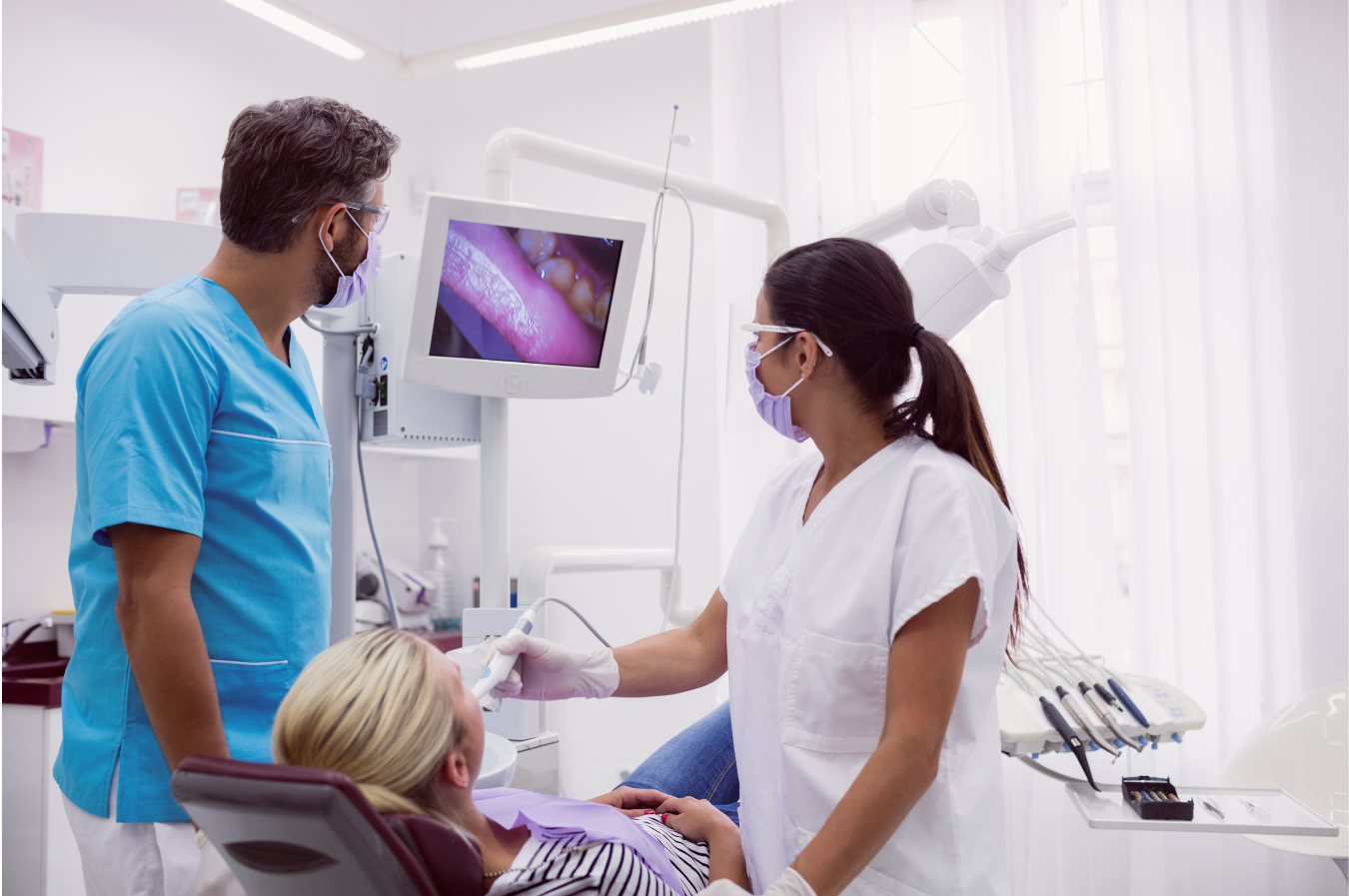
In our Oshkosh, Appleton, and Wautoma offices, treatment starts with a real exam. We use an iTero intraoral scanner to capture your teeth digitally, and CBCT imaging when we need to see roots, bone, and airway in three dimensions. That is how a doctor learns whether crowding is a simple spacing issue or a sign of something structural, and whether a tooth can safely be moved where you want it.
The plan can change mid-treatment
Mail-order series are printed up front, so the plan is essentially locked the day it ships. In our practice we routinely adjust: a tooth that is rotating slowly may need an attachment repositioned, a small amount of interproximal space created, or a new set of trays designed. Because we do our own in-house 3D printing, those adjustments do not mean waiting weeks for a lab.
Someone is accountable for the result
If something goes sideways with an app-based company, you are filing a support ticket. If something goes sideways with us, you call (920) 231-4923 and we see you. That is not a small distinction when your teeth are actively moving.
What are the real risks of unsupervised aligner treatment?
The American Association of Orthodontists has publicly cautioned consumers about moving teeth without in-person supervision by a licensed orthodontist or dentist. The concerns are consistent and clinically well understood.
Undiagnosed problems get treated anyway
Gum disease, bone loss, decay under an old restoration, root shape or length, an impacted tooth: none of these show up in a selfie. Applying force to teeth with an unhealthy foundation is how a fixable situation becomes a serious one.
Bite problems that get worse, not better
Aligners that straighten the front teeth without accounting for how the back teeth meet can leave an open bite, or leave your jaw carrying pressure in the wrong places. Straight-looking teeth and a healthy, functional bite are not the same goal. If you are unsure which category you are in, our post on overbites, underbites, and crossbites is a useful primer.
Root resorption and tooth mobility
Teeth move because bone remodels around the roots. Move them too fast, too far, or in the wrong direction, and roots can shorten and teeth can loosen. This is the risk professional monitoring exists to catch early, and it is the reason we take progress records rather than trusting a schedule printed on a box.
Refinement and retreatment costs
Patients who are unhappy with a DTC result often end up in an orthodontic office anyway, this time correcting both the original problem and whatever changed along the way. Paying twice is a common ending to the cheaper option.
Mail-order aligners vs. an orthodontist: side-by-side
| Factor | Mail-order aligners | Treatment at Vivid Orthodontics |
|---|---|---|
| Initial exam | Photos plus a self-taken impression or retail scan | In-person exam with a board-certified orthodontist |
| Imaging | Typically none | iTero digital scan and CBCT imaging when indicated |
| Who reviews your case | A remote dentist you never meet | Dr. Maslowski or Dr. Michel, in the room with you |
| Monitoring | App check-ins or uploaded photos | Scheduled in-office visits with hands-on assessment |
| Mid-course changes | Limited; the full series ships up front | Plan adjusted as your teeth respond, appliances printed in house |
| Case complexity handled | Mild alignment only | Mild through complex, including surgical and multi-disciplinary cases |
| Emergencies | Customer support channel | Call or text (920) 231-4923 and be seen |
| Retention | Retainers usually sold separately | Retention planned as part of treatment |
Is anyone actually a good candidate for mail-order aligners?
Some people with very mild crowding and a healthy, stable bite could in theory move their teeth a small amount with DTC trays. The trouble is that you cannot know whether you are that person without the exam the model skips.
The candidacy question you cannot answer yourself
Crowding that looks minor from the front can sit on top of a crossbite, a narrow arch, or gum recession. We see patients who were “approved” online for movements their periodontal support could not safely absorb. A consultation costs you nothing here and answers the question properly.
What if you already started a mail-order case?
Stop guessing and come in. Bring whatever records and trays you have. In many cases we can scan, evaluate what has changed, and build a plan forward, whether that means Invisalign, our own Confident Aligners, or braces. There is no lecture involved; we would rather see you now than after another six months of unsupervised movement.
How should you compare cost honestly?
Mail-order marketing compares its sticker price to a full course of professional treatment, which is not the same product. One is a box of plastic. The other is diagnosis, imaging, appliance fabrication, every visit, every adjustment, and responsibility for the outcome.
What is actually included
Ask what happens if the trays do not track, what refinements cost, whether retainers are included, and who pays if you need corrective treatment later. Those answers change the comparison quickly. If you are budgeting for professional care, our breakdown of what Invisalign costs and how to plan for it walks through the real variables, and our office offers a payment calculator so you can see monthly options before you commit.
Convenience, reconsidered
Aligner appointments with us are short and spaced out, and we offer a virtual consult if a first visit is hard to schedule. For most families across Oshkosh, Appleton, and Wautoma, professional treatment is far less disruptive than they expect, and considerably less disruptive than fixing an unsupervised case.
Frequently asked questions
Are mail-order aligners FDA approved?
Clear aligners are regulated medical devices, and being a legally marketed device is not the same as being appropriate for your mouth. Regulatory clearance says nothing about whether moving your particular teeth is safe.
Can a dentist or orthodontist fix a failed mail-order case?
Usually, yes, though it may take longer than if you had started with a diagnosis. We would scan and examine you, identify what moved and what was damaged, and design treatment from where you actually are.
Do I need X-rays to straighten my teeth?
For real treatment planning, imaging matters. Records let your orthodontist see roots, bone levels, unerupted teeth, and jaw relationships, which are the exact things that determine whether a movement is safe.
Is Invisalign the same as a mail-order aligner?
No. Invisalign is prescribed and managed by a licensed doctor who examines you, plans the movements, and monitors progress in person. The delivery model, not just the plastic, is what separates them. Our guide to choosing an Invisalign provider covers what to look for.
Talk to a board-certified orthodontist before you order trays
A consultation answers the only question that matters: can your teeth be moved safely, and what will it take? At Vivid Orthodontics, that visit is free, and it includes a digital scan and a real conversation with Dr. Maslowski or Dr. Michel, not a sales pitch.
We see patients in Oshkosh, Appleton, and Wautoma, and we make aligners, retainers, and appliances right here in our own office. Be Bold. Be Vivid. Be You. Schedule your free consult or call or text (920) 231-4923 to get started.