
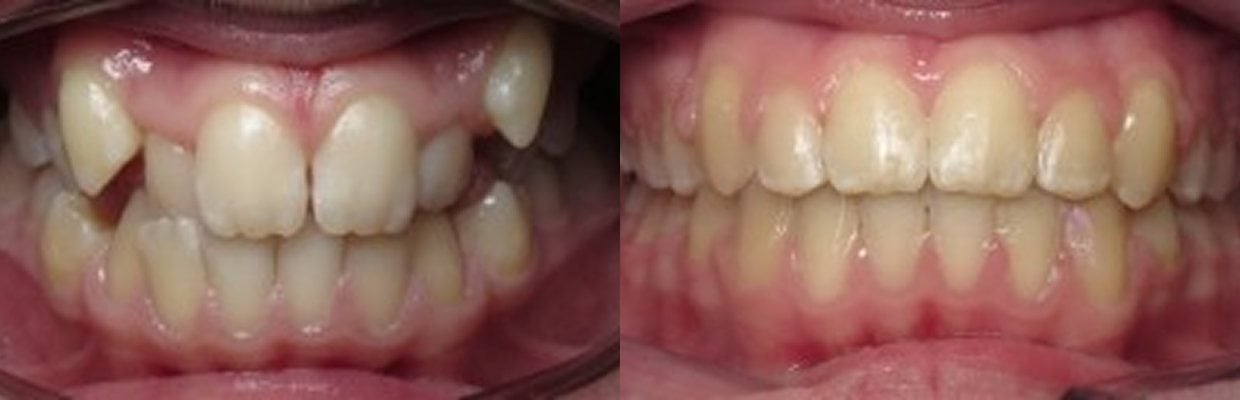
Most bite problems are fixed with braces or aligners alone. Jaw surgery is recommended when the jawbones themselves are the wrong size or position, not just the teeth. Your orthodontist confirms that with records and imaging, then plans surgery alongside an oral surgeon.
If someone has mentioned “orthognathic surgery” to you, or you have looked in the mirror and wondered why your chin, bite, or profile never quite matched, this is the guide we would hand you at a consult. At Vivid Orthodontics, Dr. Michael J. Maslowski and Dr. Brian M. Michel are board-certified orthodontists, and surgical orthodontics is one of the treatments we offer across our Oshkosh, Appleton, and Wautoma offices. Here is how we sort out who genuinely needs surgery and who does not.
What Is Surgical Orthodontics (Orthognathic Surgery)?
Surgical orthodontics, also called orthognathic surgery, combines orthodontic treatment with jaw surgery performed by an oral and maxillofacial surgeon. Braces or aligners move the teeth. Surgery repositions the upper jaw, the lower jaw, or both so the two arches finally meet the way they were meant to.
It is typically recommended for adult patients with severe bite discrepancies, jaw misalignment, or skeletal irregularities that affect chewing, speech, breathing, or appearance. The goal is not only a straighter smile. It is a jaw that works comfortably for the rest of your life.
How is it different from braces alone?
Braces and aligners are extraordinarily good at moving teeth through bone. What they cannot do is change the length of a jawbone or move an entire jaw forward or back. When the teeth are crooked, that is a dental problem. When the jaws themselves do not line up, that is a skeletal problem, and skeletal problems sometimes need a surgical answer.
Who performs the surgery?
Two providers share the case. Your orthodontist diagnoses the problem, plans the tooth movement, and controls the bite before and after surgery. An oral and maxillofacial surgeon performs the procedure itself, usually in a hospital or surgical center. We coordinate every step of your care with that surgeon so nobody is working from a different plan.
How Do I Know If I Need Jaw Surgery or Just Braces?
You do not have to figure this out on your own, and you should be suspicious of anyone who answers it from a photo. The honest answer comes from records: a clinical exam, digital scans, photographs, and imaging that shows the bone, not just the teeth.
Signs that often point toward a surgical evaluation
- An underbite or overbite that is clearly driven by jaw position rather than tooth angle
- Facial asymmetry or jaw imbalance you notice in photos
- An open bite, where the front teeth never touch even when the back teeth do
- Ongoing difficulty biting, chewing, or speaking
- Chronic jaw pain or TMJ symptoms
- Obstructive sleep apnea related to jaw structure
- Braces alone that have straightened teeth without ever fixing the bite
Signs that braces or aligners can usually handle
Crowding, spacing, rotated teeth, mild to moderate overbites and crossbites, and bites that shifted after previous treatment are routine orthodontic work. Most of the people who come in worried about surgery leave with a non-surgical plan. In our practice, that conversation happens far more often than the surgical one.
What is orthodontic camouflage?
For borderline cases there is a middle path. Camouflage treatment uses tooth movement to compensate for a mild skeletal discrepancy, tipping teeth so the bite functions well even though the underlying jaw relationship has not changed. It works beautifully for some patients and is a poor trade for others, particularly when the discrepancy is large or the profile matters to you. That is a decision to make with your orthodontist, out loud, with the records in front of you.
Braces Alone vs. Braces With Jaw Surgery
Here is the side-by-side we sketch out on the consult room screen.
| Braces or Aligners Alone | Braces Plus Jaw Surgery | |
|---|---|---|
| Best for | Crowding, spacing, and bite problems that come from tooth position | Severe bite discrepancies caused by jaw size or position |
| What moves | Teeth only | Teeth, plus the upper jaw, lower jaw, or chin |
| Providers involved | Your orthodontist | Your orthodontist and an oral and maxillofacial surgeon |
| Typical phases | One continuous phase of treatment, then retention | Pre-surgical orthodontics, surgery, post-surgical orthodontics, then retention |
| Effect on the profile | Subtle changes from tooth position | Can meaningfully change jaw and chin position |
| Recovery | Soreness for a few days after adjustments | Swelling and a modified diet for weeks, with healing continuing for months |
| Age considerations | Works for children, teens, and adults | Typically recommended for adults, after jaw growth is complete |
What Does the Jaw Surgery and Braces Timeline Look Like?
Surgical cases are longer than standard orthodontic cases, and knowing the shape of the timeline up front makes the middle of it far less stressful.
Phase one: pre-surgical orthodontics
Before surgery, braces line the teeth up within each jaw and remove the compensations your mouth developed to work around the skeletal problem. This phase can feel counterintuitive, because straightening the teeth to their true positions sometimes makes the bite look worse for a while. That is expected. Your surgeon needs the teeth in their honest positions so the jaws can be moved into a bite that fits.
Phase two: the surgery
The oral surgeon repositions the upper jaw, lower jaw, or both, and secures them in the new position. Some plans also include a chin procedure to balance the profile. The procedure is done under general anesthesia, and most incisions are made inside the mouth. Your surgeon will walk you through the specifics of your procedure, the anesthesia, and the hospital stay.
Phase three: post-surgical orthodontics and retention
Once healing is underway, we return to fine-tuning. Elastics and final adjustments settle the bite into place, and then retainers hold everything. Retention matters even more after a surgical case, because you have invested years in a result worth protecting. We fabricate retainers with our in-house 3D printing, which keeps turnaround fast if one is ever lost or damaged.
How Do We Decide? Records, CBCT, and Planning
Nothing about this decision is guesswork. It comes from diagnostics.
Digital scans and photographs
Our iTero intraoral scanner captures a complete 3D image of your teeth and bite in minutes, with no putty impressions. Combined with clinical photographs, it gives us a precise record of where every tooth sits and how the arches relate.
CBCT imaging
For complex cases and surgical planning, we use CBCT (cone beam computed tomography) imaging to see your teeth, jaw, and facial structure in three dimensions. It shows bone density, tooth position, and airway space in cross-section, which a standard X-ray cannot. For a jaw surgery evaluation, that view is the difference between an opinion and a diagnosis.
A coordinated plan with your surgeon
We share those records with your oral surgeon and agree on the movement plan before treatment starts. This kind of team-based, multi-disciplinary treatment is something we do routinely with general dentists, oral surgeons, and periodontists across the Fox Valley, so your care stays aligned from diagnosis through follow-up.
What Are the Benefits and Risks of Corrective Jaw Surgery?
What patients gain
Patients who need surgery and have it usually describe the change in functional terms first: chewing that finally works, a bite that lands evenly, speech that is easier, breathing that improves when the jaw structure was contributing to sleep-disordered breathing. Facial balance improves as well, and for many people that is the part they notice in photographs for years afterward. Correcting a bite properly also protects your teeth from the uneven wear that comes with years of poor contact, something we discuss in our guide to overbites, underbites, and crossbites.
What to weigh honestly
It is real surgery, with the recovery, swelling, diet restrictions, and temporary numbness that come with any procedure of this kind. It adds time to treatment. It requires you to be an active participant for a couple of years. Your oral surgeon will review the specific risks of your procedure in detail, and you should ask every question you have before you consent. Many patients who could have surgery choose camouflage treatment instead, and that is a legitimate choice when the trade-offs are understood.
Can jaw surgery help TMJ pain or sleep apnea?
Sometimes. Jaw alignment issues and TMJ symptoms are related for many patients, which is why chronic jaw pain is one of the reasons surgical orthodontics gets considered at all. The same is true for obstructive sleep apnea caused by jaw structure. Neither is a guarantee, and both need a proper workup. If breathing and sleep are part of your picture, our airway-focused orthodontic care and our article on TMJ disorders and orthodontic treatment are good next reads.
What Should Adults in the Fox Valley Do First?
Start with an evaluation, not a decision
The first appointment is not a commitment to surgery. It is a conversation about what is actually going on with your bite. We see plenty of adult orthodontic patients who arrive certain they need surgery and leave with a straightforward plan using braces or Invisalign. We also see patients who have been told for years that nothing could be done, and who turn out to be excellent surgical candidates.
Bring your history with you
If you had braces as a teenager, tell us. If you have a sleep study, a TMJ diagnosis, or notes from your dentist, bring them. If a family member had jaw surgery, that is useful too, because skeletal patterns often run in families. The more history we have, the faster we get to a real answer.
Frequently Asked Questions About Jaw Surgery and Braces
Do you always need braces before jaw surgery?
In the great majority of cases, yes. Pre-surgical orthodontics puts the teeth where the surgeon needs them so the jaws can fit together after they are repositioned. Skipping that step generally means a bite that does not settle properly afterward.
At what age can jaw surgery be done?
Surgical orthodontics is typically recommended for adult patients, once jaw growth is complete. In growing children and teens, we often use growth to our advantage instead, which is one of the reasons the American Association of Orthodontists recommends a first orthodontic evaluation around age seven. Early observation appointments let us track jaw development over time.
Can Invisalign be used in a surgical case?
Aligners can be part of some surgical plans, though many surgical cases are managed with fixed braces because of the precise control they give during the pre-surgical and post-surgical phases. Which approach fits your case depends on the movements required, and it is one of the first things we work out with your surgeon.
Does insurance cover corrective jaw surgery?
Coverage varies by plan, and because orthognathic surgery is often considered medically necessary rather than cosmetic, it is frequently handled differently than orthodontic coverage. We will not guess at your benefits. Bring your plan information to your consult and our team will help you understand what documentation your providers are likely to need.
Get a Straight Answer About Your Bite
If you have been wondering whether your bite is a tooth problem or a jaw problem, the fastest way to find out is to have a board-certified orthodontist look at it. Your consultation with Dr. Maslowski or Dr. Michel is free, and it comes with a real evaluation and an honest recommendation, whether that turns out to be surgery, braces, aligners, or simply keeping an eye on things.
Schedule your free consult at our Oshkosh, Appleton, or Wautoma office, or call or text us at (920) 231-4923. Be Bold. Be Vivid. Be You.