
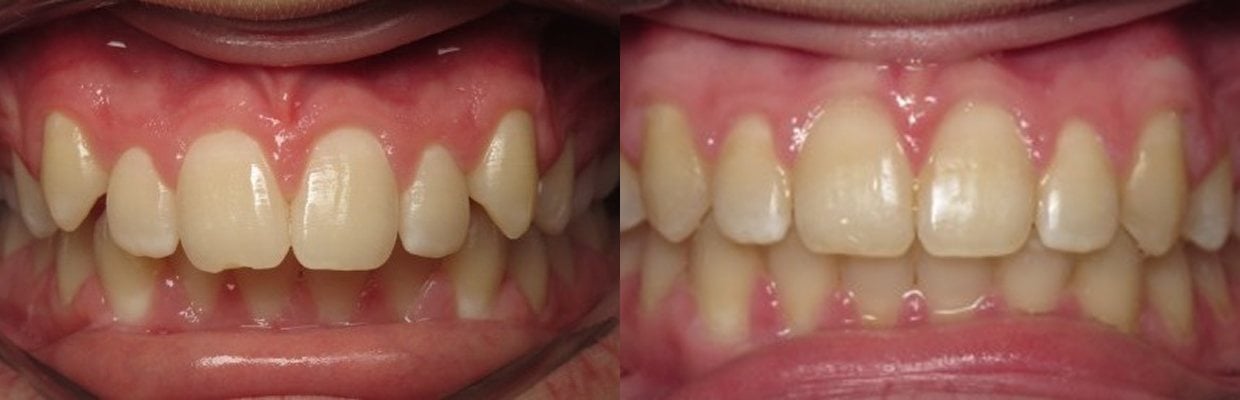
Most orthodontic treatment takes 12 to 24 months, with simple cases finishing sooner and complex bite corrections running longer. Your timeline depends on how much the teeth and jaws have to move, your age, the appliance used, and how consistently you follow instructions.
“How long will this take?” is the first question almost everyone asks in the consultation chair, and the honest answer is that a range is easy to give and a date requires records. What we can do is show you exactly what shifts the number in each direction, so the estimate you get at your consultation makes sense instead of feeling arbitrary.
How Long Do Braces Take on Average?
For most patients, braces are on somewhere between one and two years. Minor crowding or a small amount of front-tooth alignment can be finished in well under a year. A case involving significant bite correction, impacted teeth or jaw growth guidance can run past two years, and cases planned alongside jaw surgery are longer still.
Why can’t anyone give me an exact date up front?
Because teeth move through living bone, and bone responds at its own pace. Two patients with what looks like the same crowding on day one can finish months apart. A good orthodontist gives you a realistic range at the start, then refines it as they see how your teeth actually respond over the first few months.
What does the estimate at the consultation include?
At Vivid, a free consult includes a digital iTero scan and, where indicated, CBCT imaging, so Dr. Michael J. Maslowski or Dr. Brian M. Michel is quoting you a timeline based on your actual roots, bone and unerupted teeth. Both are board-certified orthodontists, which means years of specialty residency spent doing nothing but tooth and jaw movement.
What Actually Determines Your Treatment Time?
How much movement is needed
This is the biggest factor by a wide margin. Rotating a few crowded front teeth is a different job from correcting an overbite, underbite or crossbite, where the relationship between the two arches has to change, not just the position of individual teeth. Extractions, impacted teeth and midline corrections all add time.
Your age and whether you’re still growing
Growing kids and teens give us something adults don’t: active jaw growth we can direct. Adult bone remodels more slowly and doesn’t offer that lever, so adult cases with the same starting alignment often run a little longer. That’s not a reason to skip treatment as an adult; it’s just a reason to expect a realistic timeline.
The appliance you choose
Metal, ceramic and clear aligner treatment are all capable of excellent results, but they aren’t interchangeable for every case. Aligners depend entirely on wear time, while fixed braces work whether you think about them or not. Our comparison of braces versus aligners goes deeper on the trade-offs.
Compliance, which you fully control
This is where timelines quietly stretch. Elastics not worn, aligners left in a lunch bag, appointments pushed a month at a time, brackets broken by hard or sticky food. Each one costs weeks. Wearing your elastics as prescribed is the single highest-leverage thing most patients can do to finish on schedule.
Your individual biology
Bone density, gum health and how your body remodels bone all vary. Some people simply move faster. Untreated cavities or gum inflammation can pause treatment entirely until they’re resolved, which is why we want your general dentist involved throughout.
How often are adjustment appointments, and why do they matter?
Most patients come in every six to ten weeks. Those visits are not check-ins; they’re where the next movement gets activated. Wires are changed to a different size or material, brackets are repositioned, elastics are changed, and progress is measured against the plan. When an appointment slips by a month, the current wire has already finished most of what it was going to do, so that month produces very little movement. Two or three slipped visits across a case is a real reason treatment ends up months longer than quoted.
What slows treatment down most often in our practice?
In our practice the pattern is consistent, and it’s almost never mysterious. Repeated broken brackets from hard or sticky food come first, because each break turns an adjustment visit into a repair visit. Inconsistent elastic wear comes second, and it’s usually the reason a bite correction that should take six months takes ten. Third is appointment gaps, especially over summer and around the holidays. None of these are moral failings and we don’t lecture anyone about them, but we do want families to know what the trade is: every one of them buys extra time in braces.
Does the timeline change once treatment starts?
Sometimes, in both directions. After the first few months we can see how your teeth actually respond, and the estimate gets sharper. Teeth that move readily can pull a case in; an unerupted tooth that shows up in a progress X-ray, a growth spurt that changes the bite relationship, or a tooth root that needs slower handling can push it out. We would always rather tell you the timeline moved and why than take braces off early and hand you a result that relapses.
How Long Does Treatment Take for Common Problems?
These ranges are typical, not promises. Your records set your timeline.
| Situation | Typical range | What drives the time |
|---|---|---|
| Mild crowding or spacing | 6-12 months | Front teeth only; bite already sound |
| Moderate crowding | 12-18 months | More rotation and space management across the arch |
| Bite correction (overbite, underbite, crossbite) | 18-30 months | Arch relationship must change, often with elastics |
| Two-phase treatment in children | Phase 1 about 9-12 months, then a resting period, then phase 2 | Growth guidance first, full alignment once permanent teeth are in |
| Impacted tooth or surgical cases | 24 months or more | Coordinated care with an oral surgeon and slow guided movement |
What Does the Timeline Look Like Month by Month?
The consultation and records visit
Exam, digital scan, imaging, diagnosis, plan. You leave knowing your options and a realistic range. Nothing is placed at this visit.
Placement day
Getting braces on usually takes one to two hours. Nothing hurts during it; the soreness arrives a day later and fades within about a week. Our post on surviving your first days with braces covers exactly what that week feels like and what to eat.
The alignment phase
The first several months usually produce the most visible change, because crowding and rotations resolve first. This is when patients tell us they’re already happy, and also when it’s most tempting to get complacent about elastics.
The bite correction phase
The middle stretch is the slow-looking part. The teeth look fine in the mirror while we’re working on how the arches fit together. Visible progress slows down; actual progress doesn’t. Skipping elastics here is the classic way a case picks up an extra three months.
Detailing and finishing
The last few months are small, precise moves: root angles, contacts, settling the bite. It’s the difference between “straight” and “finished,” and it’s where specialist training shows.
Retention
Active treatment ends, retention does not. Teeth drift for life, and retainers are what keep the result. Our retainer guide explains the wear schedule and the types.
Can You Speed Up Orthodontic Treatment?
What genuinely helps
- Wear elastics exactly as prescribed. Full-time means full-time. This is the biggest lever you have.
- Keep every appointment. Each missed adjustment can stall progress for weeks, because nothing new is activated in the meantime.
- Protect your brackets. Every broken bracket is a repair visit that replaces an adjustment visit. Skip ice, hard candy, popcorn kernels and anything sticky.
- Brush and floss properly. Decalcification and gum inflammation can force a pause. Our post on hygiene during treatment is worth ten minutes.
- Wear aligners 20 to 22 hours a day if that’s your treatment. Aligners in a case do nothing.
What doesn’t help
Asking for tighter wires does not speed things up; excessive force damages roots and slows movement. Neither do at-home shortcuts, DIY aligners or skipping the finishing phase because the front teeth already look good. Removing braces early is how you end up back in treatment later.
Is a six-month treatment realistic?
For a narrow set of cases, yes: mild front-tooth crowding in someone with a healthy bite. Short-term programs that only align the front teeth leave bite problems untouched, and a bite left uncorrected tends to be what brings people back. A board-certified orthodontist will tell you honestly which category you’re in.
Does Treatment Time Differ for Kids, Teens and Adults?
Children and two-phase treatment
Early treatment isn’t longer treatment; it’s split treatment. A short first phase around ages 7 to 10 guides growth and creates room, then a resting period, then a shorter second phase. Total chair time is often no greater, and complex problems get much easier. See our overview of two-phase treatment for how the stages connect.
Teens
The teenage years are the efficient window. Permanent teeth are in, growth is still available, and cases move well. Compliance is the main variable, which is why we set expectations directly with the teen and not only with the parent.
Adults
Adults finish beautifully; they just need a slightly longer runway and sometimes coordination with a general dentist or periodontist for restorations and gum health. Prior dental work, missing teeth and bone levels all factor into the plan.
Frequently Asked Questions About Treatment Time
How long do braces take to straighten teeth?
Visible straightening of the front teeth often happens in the first two to six months. Full treatment, including bite correction and finishing, typically takes 12 to 24 months because alignment is only part of the job.
How long does it take to put braces on?
Usually one to two hours at a single appointment. It isn’t painful, though your teeth will feel tender for a few days afterward as they start to move.
Do braces take longer than Invisalign?
Not inherently. For comparable cases the timelines are similar; aligner treatment depends heavily on wear time, while braces work continuously. Which is faster for you depends on your case and your habits, not on the appliance alone. Our Invisalign page outlines who tends to be a good candidate.
What happens if treatment takes longer than expected?
We tell you why and what changed. Usually it’s compliance, a broken appliance history, or teeth that responded more slowly than the plan assumed. Occasionally an unerupted tooth or growth pattern changes the plan mid-course, and we’d rather adjust the timeline than compromise the result.
Get a Real Timeline for Your Smile
Averages are useful for setting expectations; they’re not a plan. The only way to know how long your treatment will take is to have a specialist look at your teeth, your bite and your imaging.
Book a free consult at Vivid Orthodontics and you’ll leave with a diagnosis, your options and a realistic range, at no cost and with no obligation. We see patients at our Oshkosh, Appleton and Wautoma offices, and you can call or text us at (920) 231-4923. Be Bold. Be Vivid. Be You.